
Safe Fumigation Practices for International Agricultural Shipping
Shipping bulk agricultural commodities across long oceanic routes presents a persistent biological challenge: pest infestation. Grains, pulses, seeds, and spices are natural host environments for stored-product insects, including the rice weevil (Sitophilus oryzae), the red flour beetle (Tribolium castaneum), the sawtoothed grain beetle (Oryzaephilus surinamensis), and the lesser grain borer (Rhyzopertha dominica). During transit through warm, humid equatorial waters, a minor insect presence inside a shipping container can multiply exponentially, destroying entire shipments, causing metabolic heat damage, raising moisture levels, and resulting in devastating financial losses.

At STOXXNOW EXPORTS & IMPORTS PVT LTD, our operational protocols treat biosecurity and fumigation as core priorities. Fumigation eliminates insect populations across all life stages—including eggs, larvae, pupae, and adults. However, executing chemical treatments on food commodities requires strict compliance with international biosecurity standards and food safety regulations. Exporters must achieve complete pest eradication without leaving toxic chemical residues or compromising consumer safety. Failure to strictly manage phytosanitary parameters can result in immediate cargo quarantine, costly port re-handling, or complete shipment rejection by international border protection agencies such as USDA-APHIS or Australia’s Department of Agriculture, Fisheries and Forestry (DAFF).
1. Biological Fundamentals of Stored Agricultural Commodities
To understand why chemical treatment must be meticulously calculated, one must first look at the respiratory biology of pest species in grain masses. Stored-product pests do not merely consume the endosperm of grains; their metabolic processes actively alter the micro-environment within a sealed cargo hold or ocean container. As insects digest carbohydrates, they produce carbon dioxide, water vapor, and heat as metabolic byproducts:
This localized increase in moisture and temperature creates “hotspots.” Hotspots accelerate grain spoilage, promote mycotoxin development (such as aflatoxins produced by Aspergillus fungi), and trigger localized sprouting. Therefore, effective fumigation is not simply an aesthetic or post-harvest cleaning task—it is an essential bio-preservation process that stabilizes commodity chemistry across multi-week oceanic voyages.
2. Understanding the Regulatory Chemistry: Phosphine vs. Methyl Bromide
The choice of fumigant chemical is governed by global biosecurity mandates, environmental protection regulations, and target insect resistance profiles:
A. Aluminum Phosphide / Phosphine (PH3) Gas
Phosphine gas (PH3) is the primary standard for treating dry agricultural commodities in international transit. Applied as solid Aluminum Phosphide (AlP) tablets or pre-packaged sachets, it reacts with atmospheric moisture (H2O) to release phosphine gas slowly over several days:
Phosphine penetrates deeply into tightly packed grain masses without affecting seed germination rates, altering baking properties, or leaving harmful chemical residues when applied correctly.
However, successful phosphine fumigation requires strict management of three critical parameters: gas concentration, ambient temperature, and exposure time. Phosphine is a slow-acting fumigant; insect mortality requires maintaining a gas concentration of at least 200 to 300 parts per million (ppm) for a minimum exposure period of 7 to 10 days at temperatures above 20°C. Applying insufficient dosage or shortening exposure times creates resistant insect strains and leads to treatment failure during ocean transit.
Phosphine Gas Decay Curve vs. Minimum Insect Lethality Threshold
Figure 2: Concentration profile over time. Solid green line demonstrates a compliant gas retention cycle; dotted orange line demonstrates treatment failure due to leakage.
B. Methyl Bromide (CH3Br) and Environmental Restrictions
Historically, Methyl Bromide (CH3Br) was widely used for rapid quarantine treatments due to its high toxicity and fast action (often within 24 hours). However, under the Montreal Protocol on Substances that Deplete the Ozone Layer, Methyl Bromide usage is strictly regulated and banned in many destination markets, except for specific Quarantine and Pre-shipment (QPS) exemptions. Exporters must verify target port regulations prior to applying Methyl Bromide, as non-compliant usage will result in cargo rejection at destination ports across Europe, Australasia, and North America.
| Parameter | Phosphine (PH3) | Methyl Bromide (CH3Br) |
|---|---|---|
| Action Speed | Slow (7–10 days minimum) | Rapid (24–48 hours) |
| Ozone Depletion Factor | Zero (Ozone Safe) | High (Regulated under Montreal Protocol) |
| Penetration Capability | Exceptional deep grain penetration | Moderate; higher surface adsorption |
| Residue Risk | Negligible when aerated correctly | Risk of inorganic bromide residues |
| Effect on Germination | Safe for seed stock at standard doses | Can significantly reduce seed viability |
3. Operational Safety Protocols: Step-by-Step Field Execution
Executing safe fumigation requires disciplined operational steps before, during, and after application:
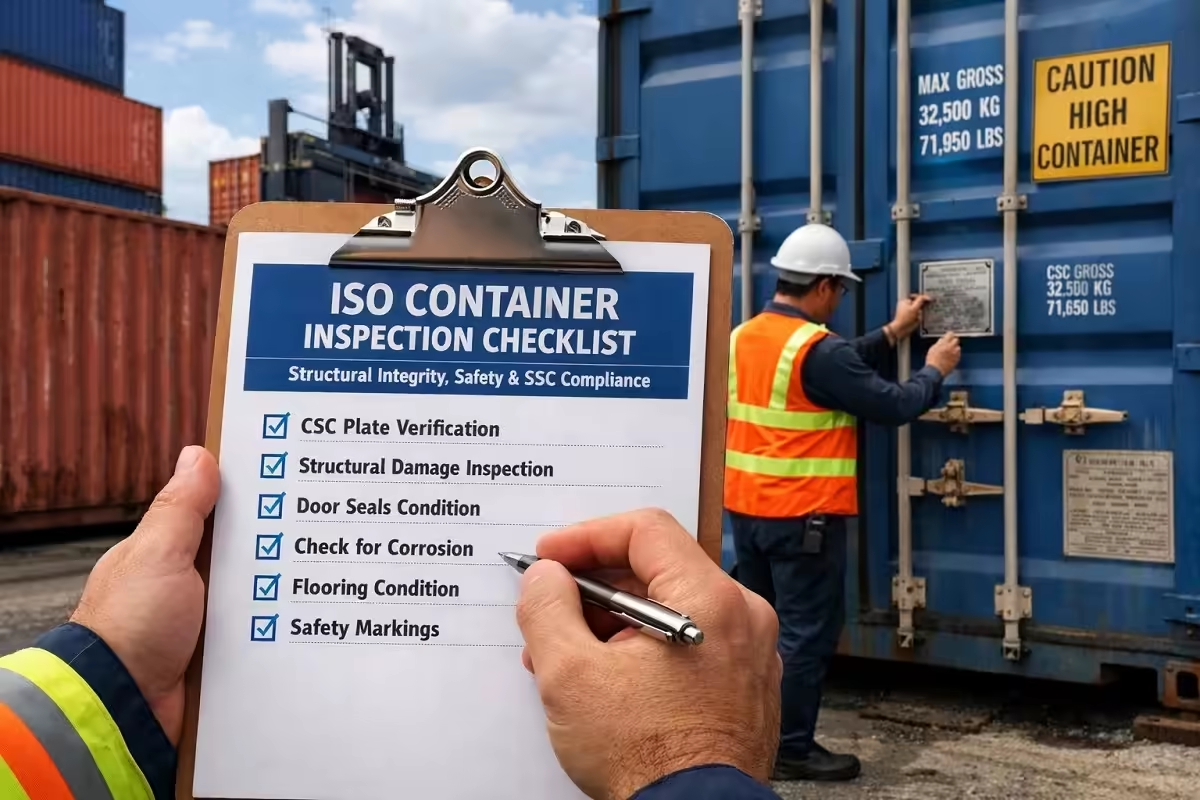
Step 1: Container Inspection & Gas-Tight Sealing
Fumigation cannot succeed in a leaking container. Prior to loading, technicians inspect shipping containers for floor damage, door gasket wear, and wall breaches. Vents must be sealed externally using heavy-duty poly-sheeting and pressure-sensitive industrial tape to ensure complete gas-tight containment during the required exposure window. Gas leaks lower concentration below lethal levels, which allows larvae to survive and breeds genetic resistance.
Step 2: Controlled Dosing and Safety Warning Placards
Trained, licensed technicians apply the specified dosage of Aluminum Phosphide sachets, distributing them evenly across the top cargo layer or utilizing specialized recirculation piping systems for deep bulk holds. Once sealed, bright yellow hazard placards must be applied to all container doors, clearly stating: “DANGER - THIS UNIT IS UNDER FUMIGATION WITH PHOSPHINE GAS. DO NOT ENTER.”
Related Reading: Quality Control Benchmarks for Bulk Pulse Exports .
Standard Fumigation and Quarantine Procedures for Grain Cargo .
Step 3: Aeration, Gas Clearance Testing, and Certification
Upon completing the required exposure period, containers must undergo thorough aeration in designated port zones. Before releasing cargo for transport or customs inspection, technicians conduct gas clearance testing using calibrated photoionization detectors (PID) or electronic gas detection tubes. Gas levels must drop below the occupational safety threshold (typically 0.3 ppm) before issuing the final official Fumigation Certificate.
4. Operational Demonstration: Shipping Container Fumigation
To observe the exact step-by-step procedure involved in sealing, dosing, and monitoring phosphine gas inside an ISO shipping container, view the operational guide below:
5. Managing Resistance and Case Analysis of Failed Treatments
Insect resistance to phosphine is an increasing risk in global agri-logistics. Over-reliance on phosphine, combined with improper, leaky seals, exposes target pests to sub-lethal dosages. Over generations, this selects for genetic traits that tolerate higher gas concentrations.
An illustrative industry scenario: a bulk shipment of red wheat is fumigated with standard dosage sachets, but the hold's tightness and relative humidity aren't checked beforehand. Low ambient humidity slows the conversion of aluminum phosphide to phosphine gas, and gas is also lost through leaky hatch covers — between the two, concentration never climbs past roughly 80 ppm, well under the 200 ppm lethal threshold. On arrival, live Rhyzopertha dominica are detected in several holds, triggering offshore quarantine and a full re-fumigation using forced recirculation. Cases like this are why gas-tightness and humidity checks at the point of dosing matter as much as the dosage calculation itself.
Key Lessons for Logistics Managers:
- Monitor Relative Humidity (RH): Ensure ambient RH is above 40% during phosphine application; dry environments severely retard gas evolution rates.
- Always Use Recirculation Fan Systems: In bulk vessel holds, passive gas diffusion is too slow. Re-circulation blowers ensure uniform distribution throughout deep grain columns.
- Verify Gas Retention at 24 Hours: Perform initial concentration checks 24 hours post-sealing. If gas levels fall below expectations, immediate re-sealing or top-up dosing is required.
6. Emerging Trends: Controlled Atmosphere & Organic Treatments
As consumer demand for certified organic, pesticide-free food expands globally, traditional chemical fumigation is being supplemented by sustainable, non-chemical alternatives:
- Carbon Dioxide (CO2) Purging: Replacing oxygen inside hermetically sealed storage liners with high concentrations of CO2 creates an anoxic environment that eliminates insects naturally without synthetic chemicals.
- Nitrogen Flushing & Vacuum Packaging: Industrial bulk vacuum packaging combined with nitrogen gas injection preserves organic pulses and nut kernels, protecting against insect development and lipid oxidation over long transit times.
- Thermal Extreme Treatments: Controlled high-temperature heat treatments (50°C to 60°C for 24 hours) or deep freezing protocols are increasingly used for small-pack specialty commodities like organic quinoa and edible seeds.

7. Summary Protocol Checklist for Export Compliance
To ensure 100% biosecurity compliance and eliminate the risk of receiving non-compliance flags, operations teams should follow this master checklist before vessel departure:
- Pre-Loading Vessel/Container Audit: Inspect structure for light leaks, water ingress, and floor board integrity.
- Commodity Moisture & Temperature Check: Verify grain moisture is below 13.5% to minimize biological hotspot generation.
- Dose Calculation: Compute exact dosage based on total cubic volume (not grain weight alone) and adjust for ambient temperature.
- Hermetic Sealing: Use heavy-duty polythene sheeting and industrial sealant on all container ventilation openings.
- Placarding & Safety Deployment: Post international biosecurity hazard notices on all exterior access points.
- Clearance Verification: Measure gas concentration using calibrated photoionization equipment before issuing phytosanitary clearance.
By enforcing precise, science-based fumigation standards and adopting modern biosecurity techniques, agribusinesses can ensure complete cross-border compliance, protect agricultural exports, and deliver clean, healthy commodities to global consumer markets.