
International Quality Standards for Bulk Pulse and Grain Exports: Regulatory and Operational Realities
Exporting bulk pulses and grains to international markets requires strict compliance with international food safety rules and contractual quality standards. Importers across North America, the European Union, the Middle East, and East Asia enforce tight specifications covering physical purity, moisture levels, chemical residues, and biological contaminants. In today's trade environment, broad quality estimates are no longer enough; every export consignment must undergo rigorous lab testing to pass border inspections smoothly.
At STOXXNOW, our export operations follow standardized grading frameworks developed by international trade organizations, including the United Nations Economic Commission for Europe (UNECE) and the Codex Alimentarius Commission. Understanding how these international benchmarks work in practice is essential for building long-term trade relationships, protecting commercial capital, and avoiding costly port rejections or demurrage penalties.
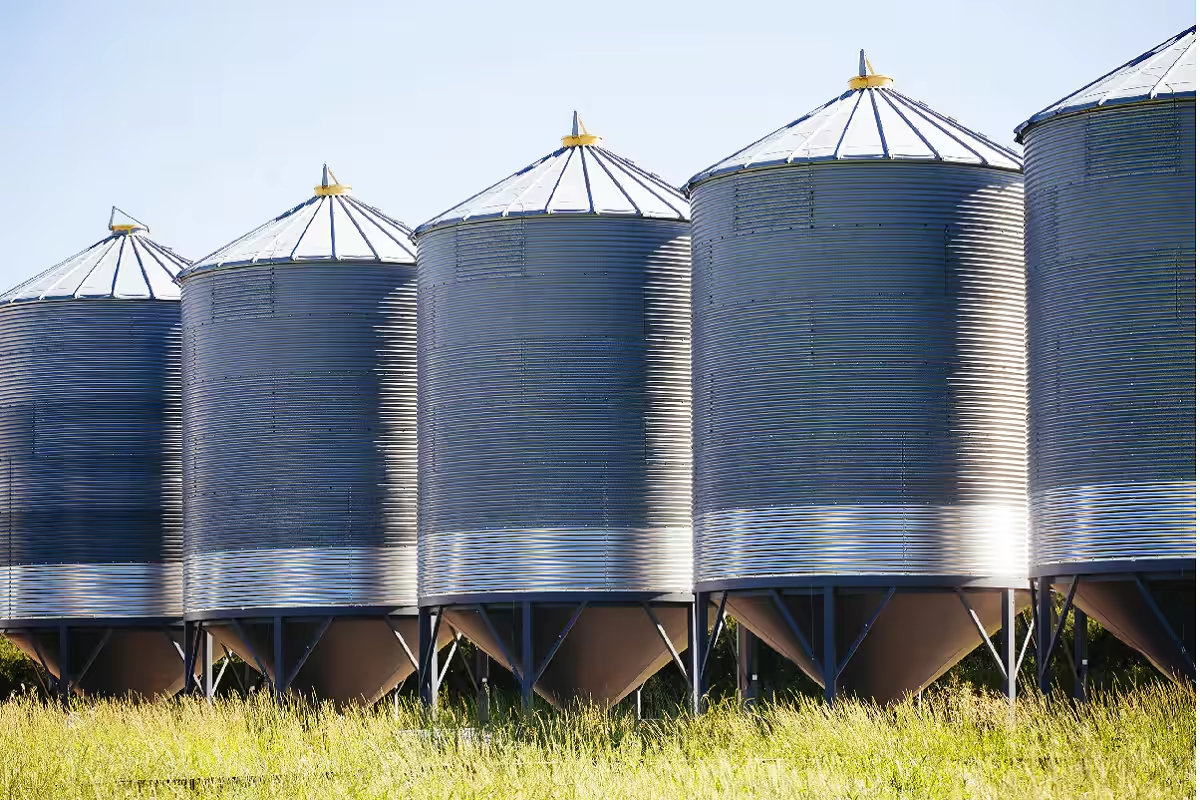
1. Physical Parameters and Mechanical Grading Standards
The commercial grade of pulses (chickpeas, lentils, kidney beans, mung beans) and cereal grains (wheat, rice, maize, barley) is determined primarily by physical metrics. Processing facilities utilize multi-stage optical sorters, gravity separators, destoners, and size-grading sieves to meet strict contract specifications. Foreign matter, physical damage, and irregular seed architecture directly impact commercial valuation and end-user milling yield.
Key Physical Quality Indicators:
- Foreign Matter Thresholds: High-value import contracts limit foreign matter—defined as non-grain organic material, stones, soil particles, plant debris, and straw—to under 0.1% to 0.5% by weight. Achieving this cleanliness requires multi-pass air screen cleaners and density separators.
- Admixture and Defect Tolerances: Strict limits govern broken seeds, split kernels, insect-damaged grains, and color variations. High-grade Kabuli chickpeas, for example, typically require a minimum 98% size and color uniformity rating (typically graded by millimeter sizing, such as 8mm, 9mm, or 10mm count).
- Chalkiness and Polishing Grades: For long-grain non-basmati and basmati rice exports, internal chalkiness (opaque white spots within the endosperm) must stay under 2% to 5% to preserve grain structural integrity during milling and maintain post-cooking texture.
- Inorganic Foreign Material (Stones & Glass): Absolute zero-tolerance policies exist in premium OECD markets for glass or metal contaminants, requiring magnetic inline traps and high-frequency vibro-destoners prior to bag packaging or bulk container filling.
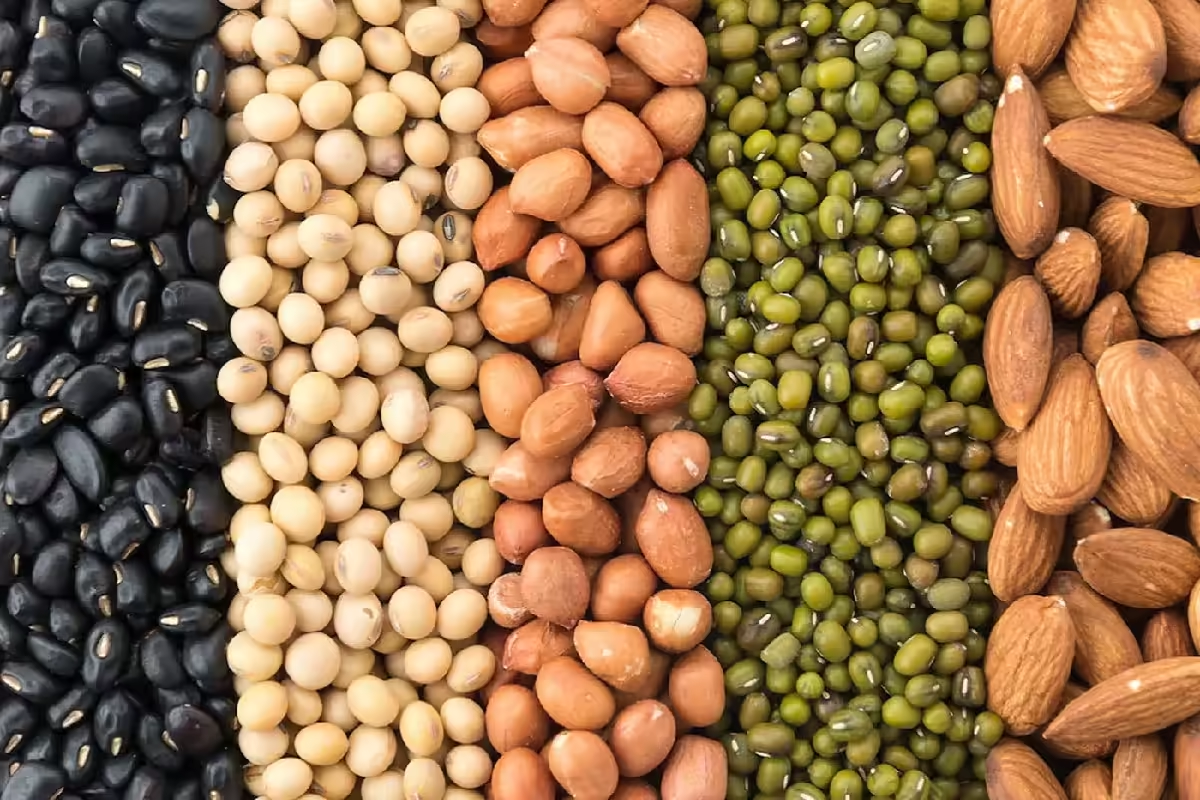
2. Chemical Safety, Pesticide MRLs, and Mass Spectrometry
Beyond visual appearance, international food safety agencies focus heavily on chemical residue testing. Customs authorities routinely test incoming cargo using Liquid Chromatography-Mass Spectrometry (LC-MS/MS) and Gas Chromatography-Mass Spectrometry (GC-MS) to detect trace pesticides down to parts-per-billion (ppb) levels.
Exporters must monitor pesticide Maximum Residue Limits (MRLs) in destination countries, which often differ significantly from local production standards. For example, glyphosate, chlorpyrifos, and neonicotinoid residue limits enforced by European Union agencies are vastly stricter than standards applied in other global trade zones. To maintain full compliance, STOXXNOW conducts systematic pre-harvest screening across our agricultural supply networks to verify zero exposure to prohibited crop protection chemicals prior to bag sealing or vessel loading.
Operational Risk Mitigation: The MRL Asymmetry Challenge
Agricultural exporters must understand that an MRL approved in the country of origin is legally irrelevant at the port of destination. If an importing nation has established a Default Limit of Detection (LOD) at 0.01 mg/kg for an unlisted compound, any detectable residue will cause immediate customs rejection, vessel quarantine, or mandatory re-exportation of the cargo.
3. Biological Safety, Mycotoxin Screening, and Moisture Dynamics
Fungal toxins, particularly toxic secondary metabolites such as aflatoxins (B1, B2, G1, G2), ochratoxin A, deoxynivalenol (DON/Vomitoxin), and zearalenone, present severe food safety risks in bulk grain shipping. These toxic compounds develop when harvested crops are exposed to wet field conditions or when humidity levels inside storage silos or shipping containers exceed safe thresholds.
European import standards limit total aflatoxin content to less than 4 micrograms per kilogram (μg/kg or ppb) in processed food grains, with B1 restricted to under 2 μg/kg. Meeting these strict thresholds requires comprehensive post-harvest mechanical drying, continuous climate monitoring in grain elevators, temperature-controlled transit management, and third-party laboratory verification via High-Performance Liquid Chromatography (HPLC) prior to dispatch.
| Parameter / Metric | European Union (EU) Standard | USDA / US-FDA Standard | East Asian Standard (JAS/GB) |
|---|---|---|---|
| Max Moisture Content | 12.0% - 13.0% Max | 13.5% - 14.0% Max | 12.5% - 13.0% Max |
| Total Aflatoxin (B1+B2+G1+G2) | ≤ 4.0 μg/kg (ppb) | ≤ 20.0 μg/kg (ppb) | ≤ 10.0 μg/kg (ppb) |
| Foreign Matter (Purity Grade 1) | ≤ 0.1% to 0.25% | ≤ 0.5% | ≤ 0.2% |
| Insect Damage / Weevils | 0.0% Live Insects / ≤ 0.5% Defect | 0.0% Live Insects / ≤ 1.0% Defect | 0.0% Live Insects / ≤ 0.2% Defect |
| Glyphosate Residue Limit | 0.01 - 0.1 mg/kg (Strict LOD) | 5.0 - 10.0 mg/kg | 0.2 - 2.0 mg/kg |
4. Advanced Processing: Optical Sorting and Quality Enhancement
Modern grain processing plants no longer rely on simple mechanical screening. High-throughput processing facilities utilize state-of-the-art color sorters equipped with RGB trichromatic cameras, InGaAs (Indium Gallium Arsenide) infrared sensors, and AI-driven image analysis. These systems inspect each grain individually at speeds exceeding several tons per hour, removing subtle discolored seeds, internal defects, ergot bodies, and micro-stones that escape traditional gravity tables.
To see how modern color-sorting machinery operates at scale to maintain international export purity standards, view the industrial process overview below:
5. Storage Science: Controlling Temperature, Humidity, and Insects
High-quality pulses and grains can spoil during transit if post-harvest storage conditions are poorly managed. Cargoes travelling across ocean trade routes face dramatic ambient temperature changes, which can lead to container sweat, moisture migration, and internal hot spots.
Essential Post-Harvest Quality Preservation Practices:
- Aeration and Moisture Balancing: Bulk grains stored in silos must undergo continuous forced-air ventilation to balance grain temperatures and lower moisture levels to under 12% before loading into sea containers.
- Hermetic Storage Solutions: Ultra-sensitive organic or specialty pulses are stored in sealed gastight bags or hermetic silos. By creating a high-carbon-dioxide, low-oxygen atmosphere naturally through respiration, insect larvae are eliminated without applying synthetic chemical fumigants.
- Desiccant Management in Ocean Containers: To prevent moisture condensation during transit, export container lining materials and high-capacity calcium chloride desiccant bags are installed along the interior container walls.
Related Reading: Millets in Global Health Food Trends .
Predicting Global Demand Shifts for Pulses & Grains .
6. End-to-End Chain-of-Custody Documentation and Compliance
Securing smooth clearance through customs depends on a clear, accurate, and verifiable documentation package. A standard agricultural export consignment managed by STOXXNOW requires a comprehensive verification portfolio, including:
- Phytosanitary Certificates: Issued by national plant protection authorities (NPPOs), confirming cargo has been inspected and found free from quarantine pests, noxious weed seeds, and seed-borne pathogens.
- Independent Third-Party Certificates of Quality & Quantity: Verified analysis performed by internationally accredited survey agencies (such as SGS, Intertek, or Cotecna) detailing exact net weight, moisture percentage, purity levels, and physical grading metrics.
- Fumigation and Treatment Logs: Official documentation confirming chemical treatment (e.g., Methyl Bromide or Phosphine dosage rates and exposure times) or natural treatment logs executed prior to container sealing.
- Non-GMO Declarations and Genetic Testing: Certificates backed by Polymerase Chain Reaction (PCR) testing confirming non-genetically modified status for export markets with strict GMO restrictions (e.g., the European Union, Turkey, and Japan).
- Radioactivity and Heavy Metal Analysis: Official lab testing confirming Cadmium, Lead, Arsenic, and Cesium-137 levels fall safely below international Codex guidelines.
Conclusion: Building Resilient Agricultural Supply Chains
Navigating global grain and pulse trade demands rigorous execution at every stage. As trade policies evolve and analytical technology improves, import inspection agencies are increasingly detecting trace impurities that were previously unnoticeable. Exporters must view quality control as a core operational discipline rather than an afterthought.
By maintaining strict quality checks across every step—from origin farm selection and optical plant sorting to container prep and third-party lab verification—STOXXNOW delivers high-grade, compliant agricultural products to global importers, ensuring efficient customs clearance on every shipment.