
Essential Customs Documentation for Seamless Global Food Trade
In international agricultural trade, managing cross-border logistics is only half the battle. Over my years overseeing global supply operations at STOXXNOW EXPORTS & IMPORTS PVT LTD, I have seen multimillion-dollar agricultural shipments delayed at container terminals not because of storm conditions or vessel failures, but due to a single misplaced digit in a Harmonized System (HS) code or a mismatched phytosanitary seal number. Frictionless cross-border food trade relies fundamentally on flawless, fully compliant customs documentation.
Agricultural commodities like organic grains, pulses, spices, and fresh vegetables are perishable biological goods. Unlike manufactured industrial components, agricultural shipments pose natural bio-security risks to destination eco-systems. Consequently, international customs protection agencies, plant health inspectorates, and port health officers apply severe regulatory scrutiny to agri-imports. A missing health certificate, an outdated fumigation record, or an ambiguous product description on a commercial invoice can quickly trigger container impoundment, massive demurrage penalties, or mandatory destruction of cargo. Establishing an accurate, systematic document validation protocol is a crucial risk management necessity for any serious import-export enterprise.
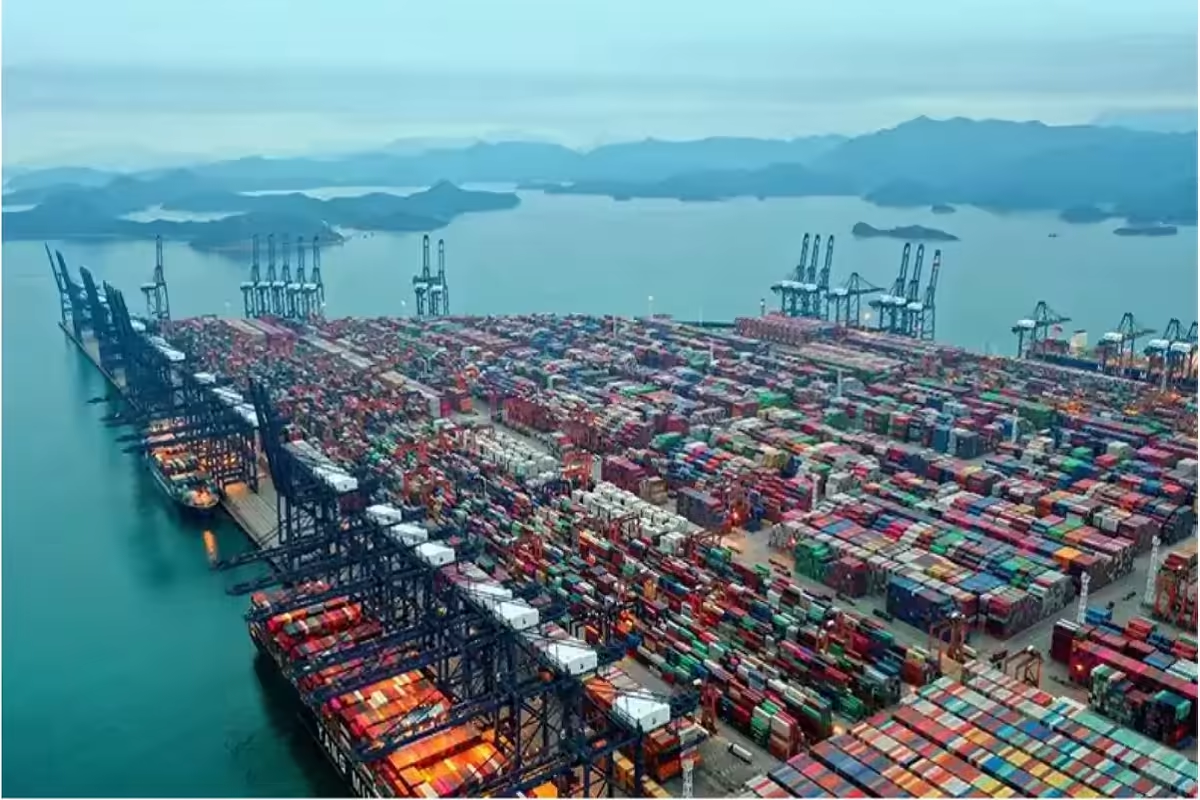
1. The Primary Commercial & Title Infrastructure
Every commercial food shipment relies on a core set of standard financial and contractual documents. However, when applied to agricultural trade, these papers demand precise technical specifics:
A. The Ocean Bill of Lading (B/L) and Multimodal Transport Documents
The Bill of Lading is the legally binding contract between the cargo owner and the ocean carrier, serving as both a freight receipt and a negotiable document of title. For bulk agricultural commodities, the B/L must precisely reflect the net cargo weight, moisture percentages at loading, and specific container ventilation settings. When shipping temperature-sensitive perishables in refrigerated (reefer) containers, the B/L must state the exact set-point temperatures (e.g., +4°C for specific fresh root vegetables or +12°C for green bananas) along with relative humidity and airflow settings in cubic meters per hour.
Furthermore, selecting between a negotiable Original Bill of Lading (issued in 3/3 sets) and a non-negotiable Express Sea Waybill or Telex Release impacts financial security. When trading under Letters of Credit (LC) subject to UCP 600 rules, banking officers cross-verify every character on the B/L against the credit terms. A single typo in the port of discharge name or an unendorsed consignee clause will lead to bank document rejection and costly payment holds.
B. The Commercial Invoice & HS Code Precision Mechanics
The Commercial Invoice provides the legal valuation base used by foreign customs departments to calculate import duties, counter-vailing tariffs, and local taxes. In agricultural transactions, vague product titles like "pulses" or "spices" are completely unacceptable. Invoices must list exact scientific botanical names, physical grade metrics, processing states (e.g., Cuminum cyminum, whole seed, double-cleaned, 99.5% purity), net metric tonnage, and agreed Incoterms 2020 definitions (such as FOB Chennai, CIF Rotterdam, or DAP Hamburg).
Furthermore, selecting the correct Harmonized System (HS) code is critical. The HS code architecture classifies commodities across 6-digit global standard numbers, extended by individual nations to 8-digit or 10-digit tariff lines. A misclassification under HS Chapter 07 (Edible Vegetables) versus HS Chapter 10 (Cereals) or HS Chapter 12 (Oil Seeds) can lead to allegations of duty evasion, resulting in severe administrative fines and long-term audits of the importing buyer's customs account.
| Incoterm 2020 Rule | Freight & Transit Insurance | Export Customs Responsibility | Import Clearance Responsibility | Risk Transfer Point |
|---|---|---|---|---|
| FOB (Free On Board) | Buyer Responsibility | Seller Responsibility | Buyer Responsibility | Gantry crane loads cargo onto vessel |
| CFR (Cost and Freight) | Seller pays freight; Insurance by Buyer | Seller Responsibility | Buyer Responsibility | Gantry crane loads cargo onto vessel |
| CIF (Cost, Insurance & Freight) | Seller pays Freight & Maritime Insurance | Seller Responsibility | Buyer Responsibility | Gantry crane loads cargo onto vessel |
| DAP (Delivered At Place) | Seller Responsibility (All Transit) | Seller Responsibility | Buyer Responsibility | Arrival at named destination terminal |
2. Specialized Biological & Bio-Security Certificates
To cross international borders, agricultural commodities require specialized biological health declarations that verify food safety and plant health compliance:
A. The Phytosanitary Certificate (IPPC Compliance) and e-Phyto Networks
Issued by the national plant protection authority of the exporting country (such as the Directorate of Plant Protection, Quarantine & Storage in India or USDA-APHIS in the United States), the Phytosanitary Certificate legally confirms that the shipment has been officially inspected and found free from regulated quarantine pests, living insects, weed seeds, and soil contamination. Obtaining this certificate requires certified field sampling and warehouse verification prior to loading.
If the certificate lacks required treatment declarations—such as specific phosphine gas (PH3) fumigation concentration rates, exposure durations, or temperature parameters—destination authorities will routinely reject entry. Leading trading hubs now utilize the IPPC e-Phyto Solution, which replaces paper certificates with secure, XML-formatted electronic data exchanges, reducing fraud risks and clearing times at import terminals.
B. The Certificate of Analysis (CoA) & Chemical Safety Protocols
Modern import jurisdictions, including the European Food Safety Authority (EFSA) and the United States Food and Drug Administration (FDA), maintain strict Maximum Residue Limits (MRLs) for synthetic pesticides, heavy metals, aflatoxins, and mycotoxins. A comprehensive Certificate of Analysis issued by an ISO/IEC 17205 accredited laboratory must accompany every consignment. The CoA provides verified analytical testing data proving that levels of compounds like Ochratoxin A, Glyphosate, Chlorpyrifos, or Lead fall safely within the legal safety thresholds of the importing country.
Standard 5-Stage Cross-Border Clearance Workflow
3. Physical Cargo Packaging & Wooden Packaging Regulations
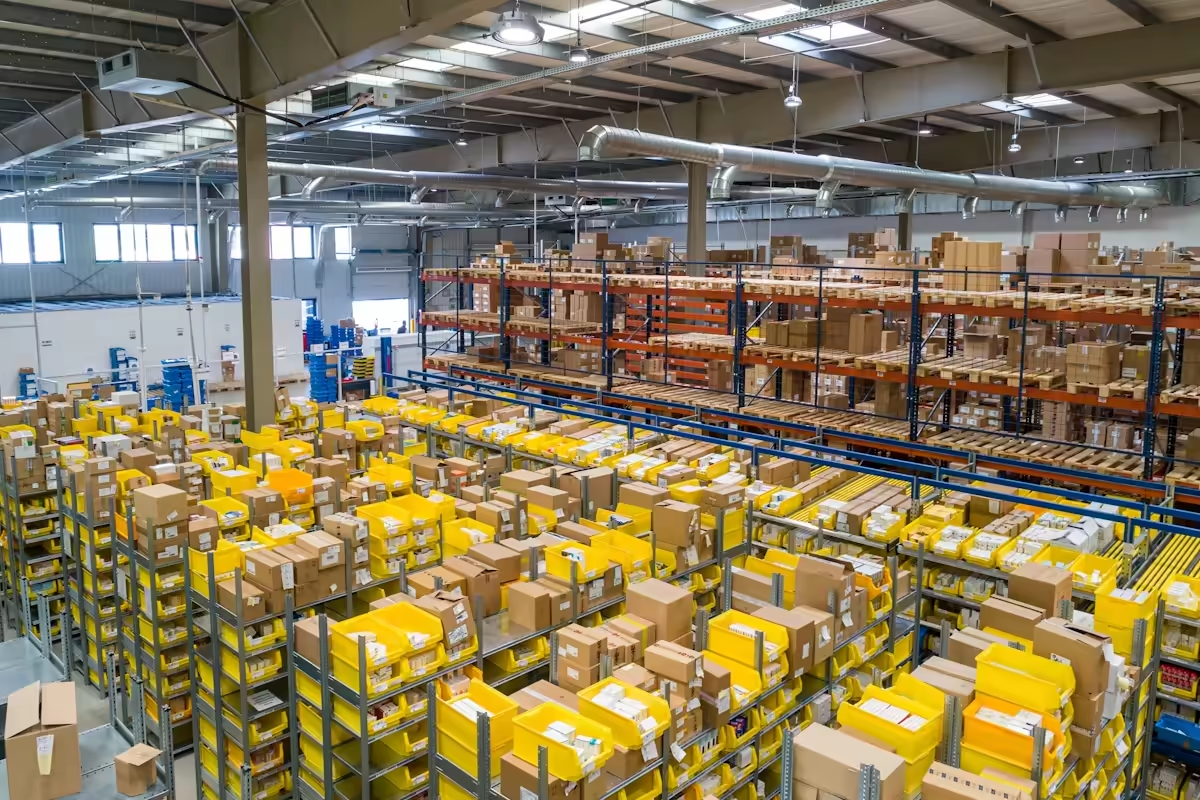
Customs inspections focus on physical container packaging just as much as the goods themselves. A detailed Packing List must outline the packaging mechanics of the container—specifying whether the items are packed in multi-wall jute bags, polypropylene woven sacks, or bulk fluid bags. If the shipment utilizes wooden pallets or timber dunnage, strict adherence to the ISPM-15 (International Standards for Phytosanitary Measures No. 15) standard is mandatory.
All raw wood packaging material thicker than 6mm must undergo certified Heat Treatment (HT) to a core temperature of 56°C for at least 30 minutes or Methyl Bromide (MB) fumigation. Compliant materials must carry the official IPPC stamp displaying the country code, producer facility code, and treatment abbreviation. Non-compliant timber packaging identified during border scans can result in immediate re-export orders for the entire container at the exporter's expense.
4. Financial Settlement & Banking Documentation (LC Rules)
In global commodity distribution, commercial transactions heavily rely on Document Credit mechanisms, primarily Letters of Credit governed by the International Chamber of Commerce (ICC) UCP 600 framework. Under LC terms, banks deal exclusively with documents rather than physical goods. Consequently, documentary discrepancies are the leading cause of payment delays and banking refusals.
Common administrative errors that trigger financial holds include:
- Late Presentation: Presenting shipping documents to negotiating banks after the presentation period stipulated in the credit (typically 21 days from the B/L date).
- Inconsistent Descriptions: Using slight variations in cargo descriptions across documents (e.g., invoice reads "Organic Red Lentils" while the Phytosanitary Certificate states "Lentils, Red Whole").
- Uncertified Corrections: Overwriting or making manual corrections on official certificates without authorized stamps from the issuing government department.
5. Mitigating Port Demurrage & Detention Expenses
One of the most immediate financial threats facing agricultural trading firms is the rapid accumulation of port Demurrage (fees charged by ocean shipping lines for using container equipment past allowed free-days) and Detention (fees charged for holding equipment outside the terminal facilities). Because agricultural consignments require multi-agency clearances—including customs, food health inspectorates, and radiation safety boards—any missing or delayed document directly incurs daily charges ranging from $150 to $400 per container.
Operational Rule: Exporters should always dispatch advance electronic copies (EDIs) of all certified documents to the destination customs broker at least 5 to 7 days before vessel arrival. This allows the clearance agent to initiate Prior Notice filings with regulatory agencies like the US FDA or EU TRACES system, securing pre-clearance status before the vessel anchors.
Summary Checklist for Exporters
To avoid customs operational bottlenecks, export teams should run this verification checklist before dispatching documentation to destination port brokers:
- Document Matching: Verify that net weights, gross weights, container numbers, and seal numbers match identically across the B/L, Phytosanitary Certificate, Commercial Invoice, and Packing List.
- Botanical Naming: Ensure every product line lists both its commercial name and technical botanical nomenclature in italics (e.g., Oryza sativa for rice).
- Consignee Details: Confirm that the Notify Party and Consignee corporate details match the importing license records on file with local port authorities.
- ISPM-15 Verification: Confirm that all wooden pallets carry legible, stamped IPPC treatment marks on at least two opposite faces.
- Timing Protocols: Ensure original paper certificates (or cryptographically signed e-Phyto documents) arrive at the buyer's clearing agency well before the vessel docks.
By enforcing a rigorous, zero-error documentation workflow, agricultural export enterprises can navigate complex international trade regulations, protect operating margins, and ensure fast, reliable delivery schedules for clients around the globe.
Explore Related Insights: Navigating customs clearance successfully begins long before port arrival. Discover how proper post-harvest handling protects your cargo from spoilage in our guide on Advanced Warehouse Management: Preventing Spoilage in Bulk Grain Silos.
Additionally, for perishable horticultural shipments, review our operational strategies in Navigating the Logistics of Fresh Vegetable Exporting.