
Demystifying the Organic Certification Process for Agro-Exporters: Step-by-Step Implementation
In the global agricultural trade, "organic" is far more than a simple marketing label it is a legally binding regulatory designation backed by rigorous oversight, stringent audit trails, and multi-year conversion mandates. For agro-exporters seeking to enter high-value consumer markets in North America, Europe, and East Asia, securing verified organic accreditation is the primary barrier to entry.
Having navigated complex international regulatory frameworks for STOXXNOW, I have seen many agricultural businesses struggle with organic compliance due to minor documentation oversights or unintentional cross-contamination along the processing chain. Achieving and maintaining organic certification requires a complete operational shift across farm management, warehouse storage, processing equipment, and transport logistics.

1. Understanding the Regulatory Frameworks (USDA, EU, and NPOP)
Before embarking on the certification journey, an agro-exporter must thoroughly comprehend the intricate landscape of international compliance. Regulatory regimes are rarely uniform; instead, they reflect distinct legislative priorities established by destination countries to protect consumer safety and environmental integrity.
Navigating these frameworks successfully demands mapping out the specific regulatory systems governing your target markets:
- USDA Organic (NOP): Governed by the U.S. Department of Agriculture, enforcing strict rules regarding synthetic inputs, soil health, crop rotation, and processing handling. It requires meticulous record-keeping of every input used from seed selection to final packaging.
- EU Organic Regulations: Overseen by European Union authorities, focusing on ecological balance, biodiversity preservation, and ultra-strict maximum residue limits (MRLs) concerning prohibited pesticide residues and environmental contaminants.
- India's NPOP (National Programme for Organic Production): The baseline regulatory framework for Indian organic exports, managed under the Ministry of Commerce and Industry. NPOP enjoys international equivalency agreements with major global markets, streamlining export procedures when managed via accredited inspection bodies.
Understanding how these systems interact prevents costly trade disputes. For instance, while equivalency arrangements reduce duplicate audits, specific labeling clauses, transaction certificate protocols, and import notification requirements still vary significantly from port to port.
2. The Multi-Year Conversion Window and Soil Integrity Management
The core requirement for organic field certification is the mandatory conversion period typically lasting 24 to 36 months depending on the land's previous crop history and historical input applications. During this phase, the land must be fully managed according to strict organic standards, even though harvested crops cannot yet be commercialized or labeled as "organic."
Cultivators must systematically replace synthetic fertilizers, herbicides, and chemical pesticides with approved biological alternatives. This transition relies heavily on green manure, natural compost, cover cropping, and integrated pest management (IPM) practices to rebuild microbial soil life.
| Transition Phase | Duration | Management Focus | Market Status |
|---|---|---|---|
| Initial Application & Audit | Months 1 - 6 | Baseline soil testing, history mapping, input purging. | Conventional Sales Only |
| Active Conversion Period | Months 7 - 24/36 | Implementation of IPM, natural amendments, buffer zones. | In-Conversion / Transitional |
| Full Certification Granted | Post-Month 36 | Maintained audit trails, annual surveillance inspections. | Certified Organic Export |
Furthermore, establishing physical buffer zones around the farm perimeter is non-negotiable. These buffers act as biological barriers comprising hedgerows, non-cropped grassy strips, or physical fencing to prevent agrochemical run-off, dust displacement, or accidental spray drift from neighboring conventional agricultural lands.
3. Preventing Processing and Transit Cross-Contamination
Securing a farm-level certificate is only half the battle. Maintaining a certified chain of custody requires strict physical and administrative separation of organic materials throughout harvesting, milling, storage, and processing operations.
When organic grains, oilseeds, or processed foods share facilities with conventional lines, the risk of accidental cross-contact multiplies. If processing equipment handles conventional crops, the entire organic batch risks losing its certified status unless strict, documented purge and cleaning protocols are executed and verified prior to running organic lots.
STOXXNOW Logistics Standard: Zero-Tolerance Separation
At STOXXNOW, our supply chain governance enforces absolute separation protocols. We mandate dedicated processing windows, comprehensive cleaning validation sheets, and independent container inspections before stuffing export cargo to protect shipment integrity.
Key operational safeguards implemented across our network include:
- Dedicated Processing Machinery: Utilizing dedicated cleaning, milling, and sorting lines for organic commodities whenever production scale allows, eliminating residual cross-contact risks.
- Verified Natural Sanitation: Employing approved, non-synthetic sanitation solutions for warehouse surfaces, conveyor belts, and shipping container walls prior to cargo handling.
- Transaction Certificates (TCs): Issuing official, government-backed or certification-body-issued Transaction Certificates for every distinct shipment lot to provide international buyers with an unbroken chain of custody.
4. Laboratory Testing and Mass Spectrometry Verification
Modern organic trade compliance has evolved far beyond simple visual inspections. Accredited third-party inspection bodies routinely conduct unannounced site visits, comprehensive soil sampling, and rigorous product testing.
Advanced analytical tools, such as liquid chromatography-tandem mass spectrometry (LC-MS/MS) and gas chromatography-tandem mass spectrometry (GC-MS/MS), scan raw samples for hundreds of banned synthetic chemicals, pesticides, and environmental pollutants down to parts-per-billion (ppb) thresholds.
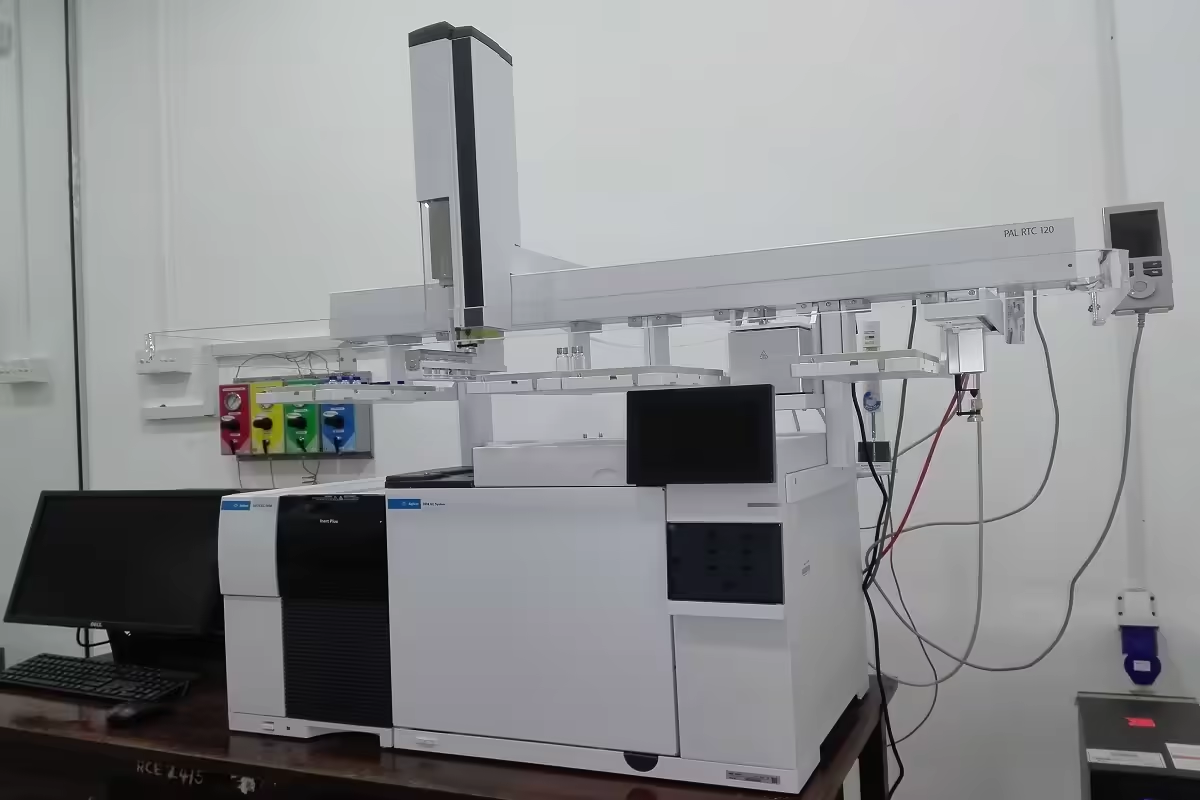
A single trace finding of an unauthorized pesticide even if caused by environmental drift from miles away can trigger immediate shipment rejection, quarantine, or suspension of the exporter's organic certificate. To mitigate these risks, our internal quality assurance protocols perform routine pre-harvest field testing and raw material screenings long before official third-party auditors arrive on-site.
5. Digital Traceability and Blockchain in Organic Export
As global supply chains expand, regulatory authorities and end consumers demand absolute transparency. Traditional paper-based record-keeping, while still accepted, is increasingly prone to human error, document loss, or fraudulent alterations.
Leading exporters are now integrating digital ledger technologies and specialized enterprise resource planning (ERP) systems to track agricultural commodities in real-time. Blockchain integration allows every stakeholder from the smallholder farmer and processing plant manager to customs officials and final retail buyers to scan a QR code and trace a lot back to its exact origin farm, harvest date, and audit log.
Key Benefits of Digital Audit Trails:
- Instant Verification: Reduces certificate verification times from weeks to seconds during customs clearance at destination ports.
- Immutability: Prevents unauthorized modifications to volume logs, ensuring that sold quantities never exceed actual farm yields.
- Consumer Trust: Enhances brand equity by offering unalterable proof of ethical sourcing and sustainable agricultural practices.
Related Reading: Modern Packaging Solutions for Reducing Commodity Loss .
Proper Storage Practices for Keeping Bulk Crops Fresh .
6. Common Pitfalls and How to Avoid Them
Even well-established agro-exporters occasionally stumble during annual recertification audits. Recognizing these frequent missteps helps businesses fortify their compliance frameworks:
- Incomplete Mass-Balance Records: Failing to maintain exact ratios between raw material intake, processing loss, and final export volume. Auditors cross-check these figures rigorously; discrepancies result in immediate non-compliance flags.
- Improper Storage Labeling: Storing organic and conventional items in adjacent warehouse bays without clear physical barriers or prominent color-coded signage.
- Lapsed Sub-Contractor Certification: Hiring third-party logistics providers, transport fleets, or secondary processing units that lack valid, current organic scope certificates.
By conducting internal mock audits, training warehouse personnel on segregation protocols, and maintaining transparent digital ledgers, agro-exporters can successfully insulate their operations against unexpected audit failures.
Conclusion: Building Long-Term Value Through Compliance
While the path to organic certification demands significant investment in capital, time, staff training, and rigorous operational tracking, the commercial return far outweighs the hurdles. Certified organic status provides long-term market stability, commands premium export pricing, and builds lasting trust with global buyers who prioritize human health, food safety, and environmental stewardship.
At STOXXNOW, we view organic certification not merely as a regulatory checkbox, but as a foundational commitment to sustainable global trade. By mastering each phase of the conversion, processing, and auditing lifecycle, agro-exporters can unlock thriving international markets with total confidence.